Work nobody has seen
Decades of Art Nobody Sees: What It Protects, What It Costs
Four painters who kept decades of work out of public view, two documented reasons people hide what they make, and what the record does not promise.
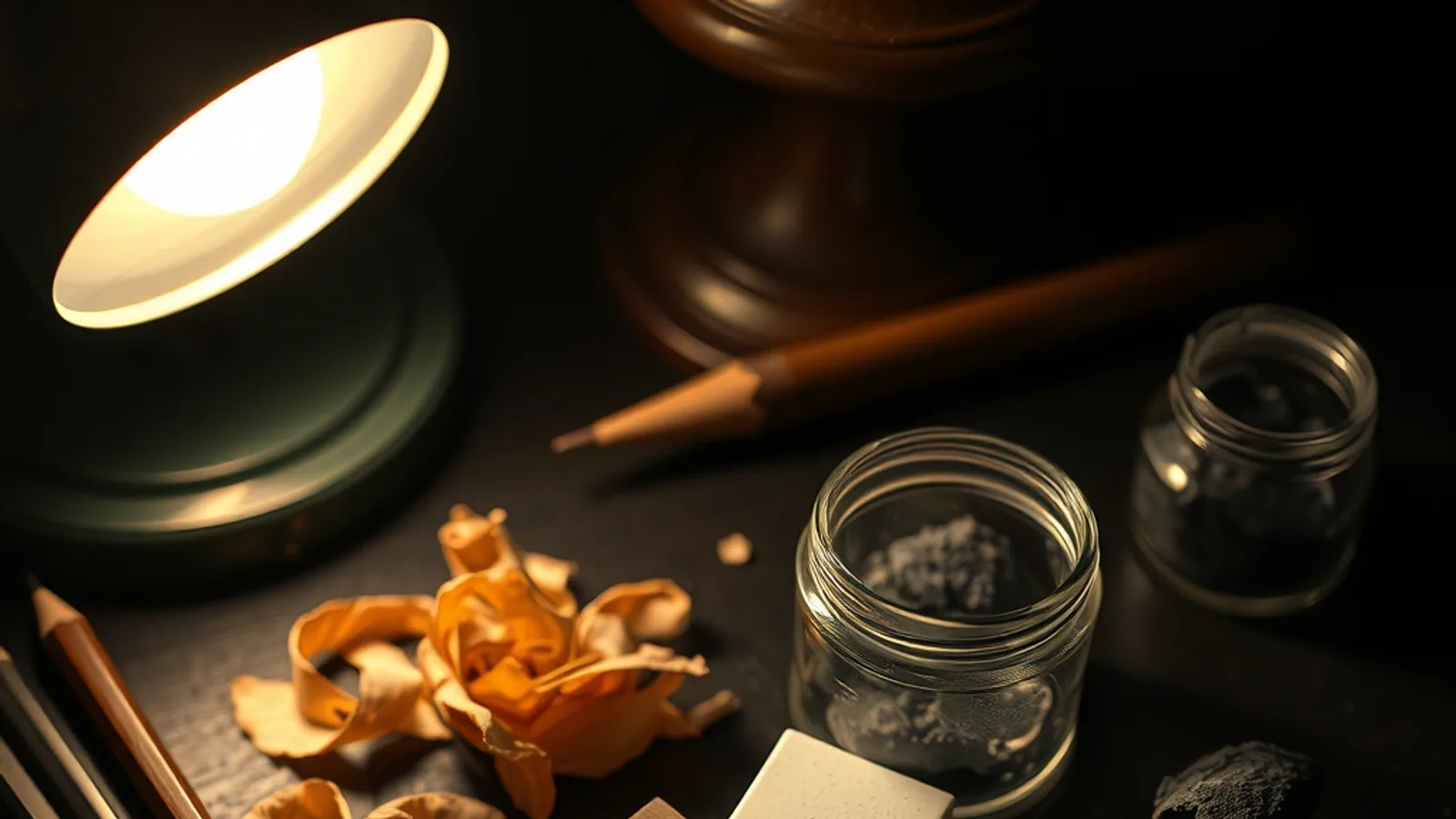
There is a folder, or a drawer, or a stack of paper under the bed. Years of work are inside it and nobody has seen them. Not a friend, not a teacher, not one person online. When the thought of showing it to someone comes up, the first question that arrives is usually not about the work at all. It is about the person: why have I kept this for so long, and was that caution or fear.
That question has no single answer, and it is worth knowing that from the start. What does exist is a record of people who did exactly this, for decades, with four completely different endings.
Four people who kept the work to themselves, and four different endings
Amira Bukak was born in Israel in 1945, an albino with a visual impairment and an official blindness certificate, and retired from a career of teaching and instruction. A Maariv report by Yuval Bageno from June 2023 states that she painted throughout her life and kept her talent to herself [1]. In her own words: "I always painted only for myself. I knew I could not be precise. I found the courage to show my paintings only once I was already a grandmother" [1].
Her caution and her craft are the same story. She describes building a working method around the limitation: large canvases so the figures are big enough for her to see, bold contrasting colours on dark grounds, and one distinct colour per figure so she can tell them apart [1]. The exhibition reported there is her fourth solo show, eight paintings at the Holon Children's Museum [1]. She broke her own silence, herself, while she was still here to watch it happen.
Zinaida Pozdniakova (1940 to 2024) arrived from the opposite direction. A Calcalist report by Yakir Segev from September 2025 states that she studied art in the Soviet Union, had real technical skill in drawing, had already exhibited in Russia, and that her work entered the collections of the Pushkin Museum and the Tretyakov Gallery [2]. She immigrated to Israel from Moscow in the 1990s, and then, in the article's own words, her first attempts to exhibit in Israel were met with rejection, and she suspected the reason was her linguistic and stylistic foreignness [2]. She lived in Jerusalem, supported herself partly by teaching art, and withdrew artistically into her home. Her Facebook page became her only window to the public [2].
The curator Yulia Yablonsky came across her name almost by chance while a graduate student at Bezalel, spent a week searching Jerusalem for her in 2021, and met her at home at the age of 82 [2]. The exhibition "Stranger" at Benjamin Gallery in Tel Aviv is the first time her work was shown publicly, a year after she died [2]. The painter Olga Kundina, who had known her since Moscow, says there: "She was very critical and always worried about how and where she would be hung. If she had been more flexible and more open she probably would have joined the New Barbizon in her lifetime, as our elder master" [2].
Pinchas Litvinovsky (1894 to 1985) is the case hardest to explain through a lack of confidence. He won the Israel Prize for Painting in 1980, was one of the founding figures of Israeli art, and painted the portraits of prime ministers and presidents [5]. Even so, as Ruti Kadosh wrote in Maariv in July 2024, he was not part of any artistic circle, did not exhibit much of his work, did not date or title his paintings, and avoided selling his own work apart from the commissioned portraits [5]. Barry Davis, writing in The Jerusalem Post about the same Beit Avi Chai exhibition in Jerusalem, adds a sharper detail: Litvinovsky "never gave interviews or responded to critiques of his work" [4].
The association named after him, founded by his two daughters in 1987, states its purpose in its own words: to bring the art of Litvinovsky to the public's attention, and "to make his many and unknown paintings a cultural asset that people can view, learn from and enjoy" [3]. That word "unknown", used by the daughters of an Israel Prize winner about their own father's body of work, is one of the sharpest things in this file. When he died his Jerusalem home held approximately 6,000 paintings, of which about 1,000 were identified as superior works and appear on the association's site [3]. And in the association's own words: "Litvinovsky, as a rule, did not sell his paintings. However, to make a living, he painted commissioned portraits" [3].
What happened to the estate afterwards is a separate story, and the two should not be blurred together. The Jerusalem Post reports that his daughter Dafna took on the cataloguing after his death, that after she died his grandson Alon was entrusted with the legacy, and that "for one reason or another, tragically, the majority of the works were subsequently destroyed, and only 600 remain" [4]. Maariv describes the same event in the same terms, a massive destruction at the hands of the painter's grandson [5]. Neither source gives a cause, so none is invented here.
Luchita Hurtado (1920 to 2020) is the one case of the four where recognition arrived in time. Wallace Ludel's obituary in The Art Newspaper records that she held one solo show in 1974 and did not have a second for more than forty years, until a small gallery show in Los Angeles in 2016 [6]. In 2018, at 97, her work was included in a major biennial for the first time, at the Hammer Museum; that same year an international gallery began representing her; in 2019 her first large retrospective opened at the Serpentine Galleries in London and travelled on to the Los Angeles County Museum of Art; in August 2020 she died at 99 [6]. She told the same paper that year: "At 99 you've lived a long time and you've been different people. When I was 30, I was one person. At 60, I was someone else. Now at 99, I'm another person entirely" [6].
Notice what this case is not. Hurtado tried once, in 1974, and nothing sustained followed. She is not someone who never wanted an audience. She is someone who asked once, was not answered, kept working for four more decades, and was still here when it arrived [6].
This category has a name, and a date
Anyone holding twenty years of work in a drawer tends to treat it as a personal and modern condition. It has a professional name and a precise date. Charlotte Flint's curatorial essay for the Barbican's Jean Dubuffet exhibition in London records that the French painter first used the term Art Brut in a letter to his friend René Auberjonois on 28 August 1945, after a trip to Switzerland to see work by people marginalised from mainstream culture [7]. In his own definition, as the Barbican quotes it, the term covers works made by people "uncontaminated by artistic culture" [7]. The English term Outsider Art came later, in 1972, as the title of a book by Roger Cardinal, who struggled with the phrase himself [7].
And one sentence of Dubuffet's own, as the Barbican quotes it, describes exactly the problem a drawer creates: "Art Brut is hidden, and help is needed to locate it" [7].
Three well-documented cases sit at the centre of that category, each a different shape of the same question.
Henry Darger (1892 to 1973) worked as a janitor and hospital worker in Chicago, wrote an illustrated novel of 15,145 pages and made hundreds of visual works across six decades, telling nobody [8]. In the words of the account of him, Darger made no efforts to publish his work, and it was unknown to others until shortly before his death [8]. The work was found in November or early December 1972, when his landlords cleared his apartment as he was moved into a nursing home, months before he died [8]. Once, when his landlord's wife changed a light bulb in his room, saw a drawing on his table and told him "Henry, you're a good artist", he answered "Yes, I am" [8]. Art scholars including Michael Bonesteel and Ellen Handler Spitz have described the work as a psychological defence mechanism, with Spitz calling it "a private pictorial tent for his own survival" [8]. That is scholars reading the work, and it carries no testimony from him about what he wanted.
Séraphine Louis (1864 to 1942), a domestic servant in Senlis, France, painted by candlelight, largely in secret isolation, until her body of work was discovered in 1912 by the German collector Wilhelm Uhde, who saw a still life of apples at his neighbour's house and learned that his own housecleaner was the painter [9]. Here recognition did arrive in her lifetime, and it did not protect her. In 1929 Uhde organised an exhibition that brought her financial success she had never known; in 1930, with the Great Depression, he had to stop buying her paintings; in 1932 she was admitted for chronic psychosis, and by that same account she died in 1942 friendless and alone, buried in a common grave [9]. Uhde kept exhibiting her work through those years in Paris, Zurich, and at the Museum of Modern Art in New York [9].
Vivian Maier (1926 to 2009) worked as a nanny around Chicago for forty years and took more than 150,000 photographs that went unpublished and unknown in her lifetime [10]. John Maloof, who acquired part of the collection, summarised what the children she raised later said about her: "She was constantly taking pictures, which she didn't show anyone" [10]. In 2007 she fell behind on payments for a storage space, her negatives and prints were auctioned, and in October 2009 the work reached the internet and became a phenomenon within weeks. She had died that April [10].
Two documented reasons people hide work
The first reason is not inside the person hiding. It is in the audience. An excerpt from Wired to Create by Scott Barry Kaufman and Carolyn Gregoire, published in Behavioral Scientist in February 2016, describes work by the psychologist Jennifer Mueller and colleagues at Cornell, published in Psychological Science in 2012: people judge creative ideas negatively relative to practical ones, even while explicitly saying they value creativity [11]. The explanation given there is the reduction of uncertainty. People are highly risk averse, and a novel idea is uncertainty [11].
The same excerpt carries a second finding: judgments of a teacher's favourite student correlated negatively with creativity, and judgments of the least favourite student correlated positively with it, even where those teachers said they liked creative students [11]. So someone who keeps work in a drawer because they expect an audience to receive it badly is not necessarily wrong about the audience. That bias has been measured.
The second reason is what the silence itself does, and this one needs a limit stated. Matthew Hutson reported in Scientific American on a study by Michael Slepian and colleagues, published in the Journal of Personality and Social Psychology in May 2017: across six studies and more than 1,200 participants, a secret damaged well-being mainly because the mind kept returning to it in private, and less because of the effort of concealing it in conversation. Active concealment did not affect well-being at all [12].
The limit belongs in the body of this article and not in a footnote. The 38 categories of secret that study actually measured are things like extrarelational thoughts, romantic desire and sexual behaviour [12]. Creative work someone keeps to themselves is not one of them. Extending that mechanism to a person who draws and does not show is an interpretation, and it appears here as one.
What the record does not promise
The comfortable version of this story says the work is found in the end, and that the thing to do is keep working quietly and wait. The four cases above do not support it. Darger never knew his work would be recognised [8]. Maier never knew [10]. Pozdniakova died a year before her first exhibition [2]. Séraphine Louis did receive recognition in her lifetime, and it did not protect her [9]. Hurtado is the one case of the four where recognition reached the person who made the work in time [6].
There is also a physical side that is easy to forget. The Litvinovsky estate shows that work kept in one house is also kept against whatever happens to that house later. When 600 works out of more than 6,000 are what remains, part of the story is who held the key and what became of them [4][5].
The record carries no clean moral here, and that is part of an honest answer. Whether to show work is a question the record does not close for anyone.
What can be decided this week
There is one distinction that can be acted on immediately, between two ways of showing work.
The first asks for a verdict. Here is what I made, tell me whether it is good. That is the way the bias Mueller and colleagues described meets at its worst, because it hands the decision to an audience that tends to prefer the familiar [11]. The second asks for a decision. Here is what I made, what should I practise next.
On the about page of this site the second way is described like this: "We look at your drawings, discuss what feels difficult and choose what to practise" [13]. On the learning page it appears as a shared look: "Look at the work together, discuss the choices made and decide what to develop next" [14]. That is not an exhibition. It is a reading of work for the sake of the next decision, and it can be done with one person.
A nearby question, about someone who stopped drawing for years and is weighing a return, was answered here in an earlier article. It is a different question from this one. There the practice stopped and the question is whether it resumes. Here it never stopped, and the question is who sees it, and when.
Sources
[1] Yuval Bageno, "I found the courage to show my paintings only once I was already a grandmother", Maariv, 6 June 2023. Amira Bukak: the biography, her own words, and the working method she built around her visual impairment.
[2] Yakir Segev, The well-known painter who came to Israel and chose to disappear, Calcalist, 10 September 2025. Zinaida Pozdniakova: the training, the first rejection in Israel, the withdrawal, the curator's find, and the Olga Kundina quote.
[3] Pinchas Litvinovsky Association, the site of the association founded by his daughters. Its purpose in its own words, the number of paintings in his home at his death, and his approach to selling work.
[4] Barry Davis, Art for life: Beit Avi Chai unveils work of a giant of the art world, The Jerusalem Post, 2 August 2024. The absence of interviews and replies to criticism, the chain of custody of the estate, and what remains of it.
[5] Ruti Kadosh, The recommended unique cultural events coming up, Maariv, 17 July 2024. A second independent confirmation of the estate's fate, and of his avoidance of artistic circles and of exhibiting.
[6] Wallace Ludel, Luchita Hurtado, painter who gained greater fame later in life, has died, aged 99, The Art Newspaper, 15 August 2020. The chronology from 1974 to 2020, and her own words to that paper. The quote about mortality in the same obituary was originally said to T Magazine, so it is not used here.
[7] Charlotte Flint, Jean Dubuffet: Brutal Beauty, curatorial essay, Barbican, London, 2021. The date the term Art Brut was coined, Dubuffet's own definition, the sentence about hidden work, and the 1972 origin of Outsider Art.
[8] Henry Darger, English Wikipedia. The scale of the work, when it was found in his apartment, his reply to his landlord's wife, and the Bonesteel and Spitz readings.
[9] Séraphine Louis, English Wikipedia. The 1912 discovery, Uhde's exhibitions, the end of his patronage in 1930, the 1932 admission and the 1942 death.
[10] Vivian Maier, English Wikipedia. The forty years as a nanny, the scale of the photography, Maloof's summary, and the 2007 storage auction.
[11] Carolyn Gregoire and Scott Barry Kaufman, The Bias Against Creativity, Behavioral Scientist, 22 February 2016, excerpted from their book Wired to Create. The Mueller, Melwani and Goncalo study in Psychological Science, 2012, and the teacher finding.
[12] Matthew Hutson, Why It's So Hard to Keep a Secret, Scientific American. The Slepian, Chun and Mason study in the Journal of Personality and Social Psychology, May 2017, and the categories it actually measured.
[13] Muli Asido, About. The wording of "How I teach" on the page itself.
[14] Muli Asido, Learn. The wording of "A shared look" on the page itself.
A short conversation is enough to know if this is the right path.
Contact MuliContinue the conversation
What in this article connects with your own practice? Share a question, a thought, or something you have learned.
Loading the conversation…